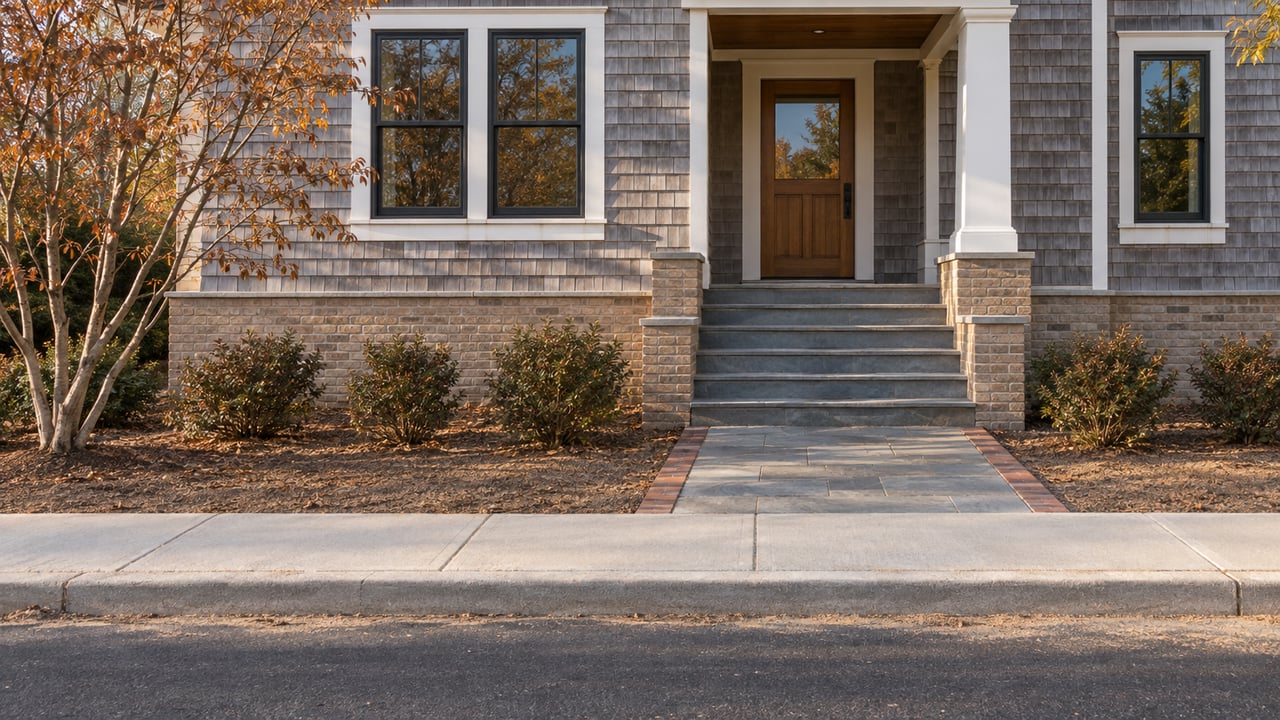
On September 8, a South State Inc. crew from Bridgeton started digging test pits along 42nd Street between Ocean Drive and Fifth Avenue. The plan was to wet tap the main at 42nd and Fourth the next day, then lay new water main south down Fourth Avenue. It's a $4.4 million project that will bring new 8 to 10 inch mains to 42nd Street, Pelican Drive, Flamingo Drive, Heron Drive, Seagull Drive, and Fourth Avenue south to 42nd. It finishes with full repaving in November 2027.
The Borough's project page also carries a sentence for anyone buying on those blocks. "When the street is repaved at the end of the project, a five-year street opening moratorium will begin, lasting into 2032."
If you're buying a lot to build on, or a house you plan to gut and re-plumb, the paving date on your street decides when you can still get a new water or sewer line run from the curb to the main. On a street that's about to be repaved, that window closes on the Borough's schedule, not on yours.
What the Code Actually Says
Avalon added the rule in 2022 through Ordinance 847-2022, and it sits in Chapter 15 of the Borough Code. Section 15-1.41(a) reads:
"No permit shall be issued for any street opening which would disturb the pavement of any road having been constructed, reconstructed, or overlaid until a period of five years after the completion of said construction, reconstruction, or overlay, except in the event of an emergency or hardship as described in this section."
The emergency exception is narrow. The chapter defines an emergency as a condition posing an immediate threat to health, safety, welfare or property that needs urgent repair. Its examples are a ruptured sewer, water or gas main, a gas leak likely to cause an explosion or fire, and a medical, fire or police emergency at an address on the street. A planned new service connection isn't among the listed examples. Another section of the same chapter allows permits on a moratorium street only "in the case of a bona fide emergency." Section 15-1.41(a) also says "hardship," but the surrounding sections never say what a hardship is or how to qualify.
The Borough's own construction page goes further than the code. It says no street openings are permitted or approved for five years after paving, "for any reason." A buyer counting on an exception would be relying on a word that the Borough's public guidance leaves out.
The penalties are steep. An opening that violates the moratorium costs $2,000 the first time, $5,000 the second time and $10,000 for each one after that. The count follows the responsible party to any moratorium street in Avalon, not just the street where the first violation happened. The responsible party also has to mill and repave 100 feet of street, as the Borough Engineer determines. That repaving requirement applies even when a moratorium street is opened for a genuine emergency.
The Calendar Closes Faster Than the Five Years Suggest
The five-year rule gets the attention, but the seasonal rule takes even more time off the calendar. Under the code, street openings generally aren't allowed from May 15 to September 15 of any year, except for a bona fide emergency. Avalon's summer is off the table every year, moratorium or not.
Here's how that lines up with the 42nd Street project as the Borough has published it:
- September 2026. Work began after Labor Day, starting with test pits and possible well points where the water table under the road is high.
- May 15, 2027. The code's seasonal ban on street openings starts.
- No later than May 26, 2027. The project stops for the summer.
- September 15, 2027. The seasonal ban ends.
- November 2027. Final paving, and the five-year moratorium starts.
- Into 2032. The moratorium runs out.
For anyone who closes on a house on Heron or Seagull Drive in early 2027, that adds up to a few months this winter and spring and a few weeks next fall. After that, the street is under moratorium into 2032, and the code allows openings only for an emergency or hardship. The Borough's project page doesn't tell owners to schedule their own service work before paving. Whether the timing works for a particular lot has to be asked directly, because nobody is going to bring it up for you.
How a New Service Line Gets Ordered
The timing is tight because the process has several hand-offs, and none of them can be rushed. Avalon's new construction checklist, dated 9/23/2026, gives water and sewer a single line: "Water & Sewer if applicable with $100.00 application fee." The Borough's water and sewer instructions lay out the steps. The page is labeled a 2016 update, so confirm current details with the Borough before relying on it.
- The owner or contractor applies with the Borough and pays the $100 fee.
- The service location has to be staked at the curb, away from driveways, walkways, trees and bushes. If it isn't staked, the instructions say, "the service will not be priced or installed."
- The Water Company sends a price back to the Borough in about three business days, and the builder or owner pays it. The Borough doesn't publish a fixed tap price. Each job gets its own quote.
- After payment, the Borough sends the installation request, and the Water Company has 30 days from that request to do the work.
- A meter is set only after the plumber connects the service to the meter box. It's requested through Avalon Construction, and the builder or owner has to be there when it's installed.
Chapter 15 also limits who can apply to open a street at all. Only public utilities licensed and regulated by the New Jersey Board of Public Utilities can apply, and a contractor doing the work for one has to co-apply. Work entirely on the property side of the curb needs no street-opening permit, as long as it doesn't involve digging or directional drilling under the street. Ordinary permits run $100 plus $75 per opening for minor work, or $750 plus $75 per opening for major work, plus an escrow of at least $2,400. Allow about a month for installation after the request goes in, plus pricing, plus the 20 business days the code gives the Public Works director to issue or deny a permit once an application is complete. A builder who waits until spring to order a tap on 42nd Street may run into May 15.
42nd Street Isn't the Only Street on the Schedule
The same question applies to other streets about to be rebuilt. On October 14, 2026, Avalon awarded Contract M-149 to Fred M. Schiavone Construction for $583,434.60 to reconstruct 21st Street from First Avenue to Avalon Avenue. The award notice gives no start date. The Borough's bid listing also showed Contract M-150, "20th Street Water Main Upgrades," dated October 15, 2026. That's a bid, not an award or a paving date.
The quickest way to check any particular block is the Borough's street moratorium map, which the Borough says is accurate to within 48 hours. Red streets are under moratorium now, and clicking one shows when it expires. Blue streets are about to go under one. Green streets aren't under one, and yellow means nothing for this purpose. For a lot you're serious about, the color of the street out front is as useful to know as the setbacks.
What to Ask Before You Sign
These questions turn the paving schedule into terms you can negotiate:
- What color is the street on the moratorium map today, and if it's red, what's the expiration date?
- Does the existing water and sewer service fit the house you plan to build, or will the plans need a new tap?
- If the street is blue, when does the Borough expect to pave, and how many weeks fall outside May 15 to September 15 before then?
- Can the builder get a staked location and a service application in before closing, or does the contract timeline push it past the window?
- Does the work stay entirely on the property side of the curb, or does it go under the street?
Everything above describes the Borough's published rules and project schedules as general information. It isn't legal or construction advice, so confirm your own lot with the Borough of Avalon, your attorney and your builder before you commit.
A Few Questions I Get About This
Does the moratorium stop me from building? The moratorium applies to opening the street. Under Chapter 15, work entirely on the property side of the curb, with no digging or drilling under the street, doesn't need a street-opening permit.
Will I lose water during the 42nd Street project? The Borough says homes in small sections may lose water for up to eight hours during the day, with 48 hours' notice when possible, and never overnight. Driveway access stays open the whole time.
Does the project lose any parking? In a few spots, ADA-compliant ramps required by law will take up a street-side parking space.
If you're looking at a lot on 42nd Street, the bird streets, 21st Street or anywhere else on the Borough's schedule, I'm glad to pull the map, go over the timing with you and your builder, and figure out how much of the window is left before you make an offer. Joseph Butler has been working these blocks year-round for a long time. Let's Connect.